


Photos: Durgada Krishnappa · Public domain ; Javagal Narasimhayya · Public domain ; Subha murugan · CC BY-SA 3.0 (tap a photo for its source)
GI handicraft GI registered (IP India) GI 2006
Mysore Traditional Paintings
From: Mysuru, Mysuru district · Mysuru · Karnataka
- Community
- Chitragara painters of Mysuru
- Materials
- paper, cloth or wood base, natural and mineral pigments, gesso paste, gold leaf
- Products
- gesso paintings of deities, framed wall paintings, Ganesha and Krishna paintings
The story
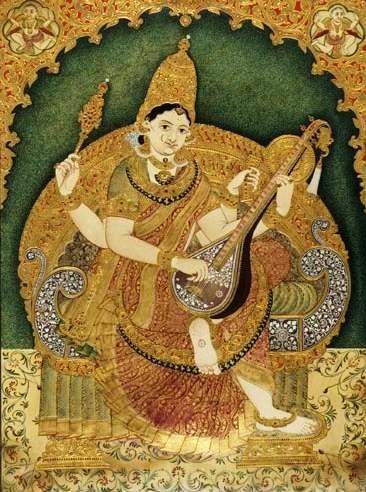
Mysore painting is a classical South Indian style that grew under the patronage of the Wadiyar rulers of Mysore, especially Krishnaraja Wadiyar III in the 19th century. It developed from the painting traditions of the Vijayanagara empire, whose artists moved to Mysore and nearby courts after the empire declined. The paintings usually show Hindu gods and goddesses and scenes from the epics, framed by architectural elements. Raised gesso work covered with thin gold leaf gives the jewellery and thrones a gentle glow, which is less heavy than in Tanjore painting. Artists traditionally used natural pigments and fine brushes. Mysore Traditional Paintings received GI registration in 2006.
How it’s made
A base is prepared and a sketch drawn; raised areas for jewellery and architecture are built up in gesso (a paste of white lead, gamboge and glue), covered with gold leaf, and the rest is painted in fine, muted colours.
Awarded master artisans
- Prabha Mallesh — Shilp Guru, 2013 · Karnataka
- Y. Subramanya Raju — National Award for Master Craftspersons (Handicrafts), 1987 · Karnataka
More from the trail
Related crafts


